back
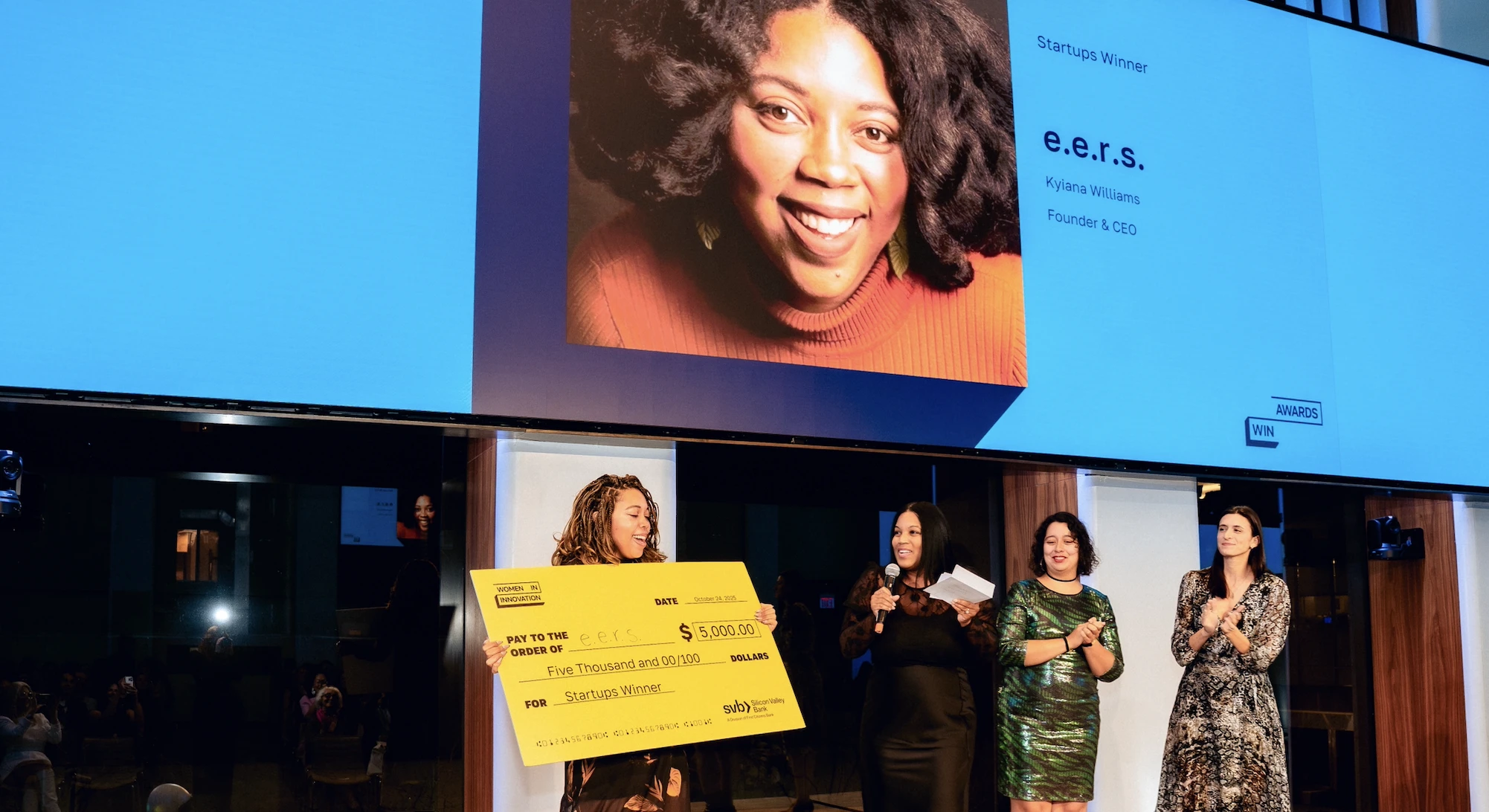
Start-up Interview Series: Meet Kyiana at e.e.r.s.
February 9, 2026
Social Impact
Startups & Ventures


WIN
What is the story behind e.e.r.s?
Kyiana
e.e.r.s was initially built as a tool inside my first company, entertwine. My team and I developed an algorithm that provides recommendations to underserved aspiring filmmakers and storytellers to find resources in the entertainment industry. That algorithm, for example, matched 600 women of color entertainment novices with 100 seasoned mentors using 25 data points—including essays. The AI achieved 80% accuracy in seconds, replacing a manual review process that typically took six to eight weeks.
Later on, a business professor noticed what we were doing and asked us, “Have you thought of changing the world?” Have you considered how this could be used for cancer research? AIDS research? For suicide prevention? Could this tool help social workers find resources while taking suicide calls?
After that nudge, we decided to research the 988, a crisis hotline, and develop our algorithm more aggressively toward civic resources.
The stress of managing the calls overwhelmed the 988 phone agents, who were mostly women. They were having trouble navigating local resources (e.g. abuse shelters, rehab centers, community counseling, etc.) while also listening to the person in crisis share their struggles. We approached them about using e.e.r.s as a crisis chatbot, and they loved it.
So initially, e.e.r.s. was supposed to help agents with suicide calls. But it still worked in the same way for all social services. Then cities started picking us up. It wasn't until the Los Angeles fires in 2025 - and my grandparents’ home burned down—that we realized we wanted to be able to help during the most intense time of need. We had been helping communities in a regular manner, without a sense of urgency, but after the addition of the fires, which felt particularly personal to us as a California company, our experience changed significantly.
WIN
Can you tell us more about your first company?
Kyiana
entertwine is an arts company where we provide opportunities for filmmakers and people who do theater. We help people navigate that space, whether they're coming in new or they're in between gigs. We help them find jobs, projects, and events, and we provide classes. So while we were accumulating a lot of this data, we realized an Excel sheet and a newsletter with thousands of data points weren’t helpful to someone who didn't know what they were looking for. It's just an overwhelming sheet of data. So we asked, how can we make this more engaging? How can we make this more discoverable? We initially built e.e.r.s. to recommend opportunities to artists in the entertainment industry, giving them a more curated, personal experience. And later, I thought, “Could we do this with other data?”
WIN
What were some of the challenges or major realizations you had when moving from a people-driven business to a tech-driven one?
Kyiana
Both companies remain fundamentally driven by people. My philosophy has always been to lead with a human-first mindset. Technology is simply a tool to make people’s lives better, and in both e.e.r.s. and entertwine, we use tech to support underserved communities who need access to resources.
entertwine served as the ideal training ground for developing e.e.r.s. I’ve been running entertwine since 2019, and the lessons from that experience were invaluable. One of the biggest realizations was that the data isn’t as different as people assume. At entertwine, we pull from places like the National Endowment for the Arts for fellowships and grants. The Department of Education has similar opportunities—they’re just not art-focused. Once I understood that, it became clear that the shift wasn’t a leap into a new world; it was simply expanding into more data.
Advisors have always reminded me that strong products start with people. After five years, we’ve learned how to gather clean, trustworthy data and how to validate ideas directly with the communities we serve. Sitting down with the people involved in entertwine and asking, “How does this feel? What’s working for you?” was crucial. Their feedback helped us see that this wasn’t just an artist's problem—it was a social worker’s problem, a lawyer’s problem, and a financial advisor’s problem. The need was universal.
From there, we focused on understanding how humans actually want to interact with technology. We spent years refining user experience, studying how people engage with tools, and making sure the technology feels supportive rather than overwhelming. At every step, being human-first guided the process.
WIN
This is a very common thread of what I hear from a lot of the startup founders I talk to: that it needs to be human first, no matter what platform or format you're working in.
Kyiana
There have been times when I've wanted to throw technology at a problem. Sometimes, we choose the wrong type of technology, or it doesn't meet everyone's expectations. You have to go back and build the right one for the people that you're trying to serve. We always keep that in mind.
WIN
As a two-time founder, what was one of your biggest challenges trying to either get the company off the ground or physically build the product?
Kyiana
I think when I initially started entertwine I was a playwright, and my idea was a result of my situation. I couldn’t seem to find a job, fellowships, or even the applications to submit my work. I didn’t know where any of this lived. After a year, I sat back and realized that I had created something special for people to use. Of course, I wanted more people to use it, but it still accomplished the purpose I intended. I learned about setting an achievable goal. I also learned to be kind to myself when entertwine didn't dominate the free world. Despite its lack of dominance, its technology still holds immense value because it’s being poised for global use through e.e.r.s.
With my second company, e.e.r.s., the challenge is adjusting to the different rules of government.
When you're in the government, you must serve many people. We had to show that we are a robust and reliable company with stability. Our job is to reassure people that we are not "fly-by-nights" and remind them that we have been around for years. We also understand that e.e.r.s is a new category of service, so there is an education curve for our clients. We also use AI technology, which has not always had a favorable impression in pop culture.
WIN
What's the part of your pitch that helps people get over the fear of AI or technology overcoming a very human process?
Kyiana
It depends on who I'm talking to. When I'm talking to an artist or a small business owner, I remind them that autocorrect—which we've all used for decades - is an AI. We rely and use AI and robotics daily without even realizing it. A car's cruise control system is an example of this; that's a car driving by itself.
People go to the movies and see physical robots becoming sentient and destroying their livelihood. Still, there are AI futures where the AI is the supporting character to the human hero and not the villain.
For instance, in The Jetsons, they have a robot maid who makes life easier for the family. You can create the future that you want to see.
When I pitch e.e.r.s. to investors and civic organizations, I use that perspective. The reality is that humans alone cannot adequately serve the number of people in our country and around the world. This ratio will never be sustainable. And that's where technology is supposed to help us improve.
WIN
There is such a human focus that comes through in the way that you talk about the things that you've done and what you're working on. It’s beyond lovely. What's one thing that you wish you had known when you started either of your companies?
Kyiana
I have come to realize that certain companies do not require venture capital or investor funding. It took me maybe three years at my first company to realize that this actually isn't an investor-friendly company. I greatly appreciate running an arts company as my first company, because it forced me to look at how nonprofit art companies run. You hustle differently because you understand that money will not come easily. Having trained in the arts, I always knew that I was going to have to be scrappy. I really pushed to get support in different ways. I organized large events costing $10,000, during which I rented spacious theaters, hosted film festivals, secured donated venues, and coordinated numerous volunteers on a fraction of that budget.
That's where I think the best part of running an arts organization has benefited me. Now, when I get money, it lasts.
While my first company wasn't VC-backable, my second company, e.e.r.s. is. The goals are different, and the growth is different.
WIN
For other people who might be looking to start their first venture, what would you tell them as advice? Or things to think about, or ways to structure their own process?
Kyiana
One way is to address a problem that you are certain is a genuine issue rather than merely a “good idea.”
Second, it’s not easy for any startup to receive funding. It’s especially challenging for women. Despite receiving grants and working full-time at e.e.r.s., I work on the side to cover healthcare and other expenses.
There's nothing wrong with being fiscally responsible, especially if you can't get funding or that grant or loan. It’s important to strike a balance between securing the life that you desire and “being an adult.” I often feel like a cast member of Orange is the New Black. Half the cast had outside jobs. They were teachers or worked at a store, they needed to have a flexible job so they could be on set and pay their bills. This is what happens when most of us pursue bigger dreams: we make it work.
As an entrepreneur, I'm glad I have an artist spirit. My company is my future, and I wish I didn’t need to work outside of e.e.r.s., but I still have to live. And my startup journey only gets better. I recently joined the Los Angeles Cleantech Incubator’s (LACI) Resilient Rebuilding Cohort to help build e.e.r.s. and give us more “institutional weight.”
In addition, I’ll be pitching at SXSW this year, and I am so excited. I am determined to get the funding I need and take e.e.r.s. to greater heights.
WIN
I'm curious how you see WIN as a part of your process now. How do you see us, or how would you want us to be able to kind of create space for you in the future and support you in the future?
Kyiana
I'd love to be a part of the WIN events. I know WIN has a San Francisco chapter where I am based. I plan on joining that chapter. I also want to have WIN as a fiscal sponsor for when I have grants that I can't take by myself.
It’s a joy to be a part of an organization that I want to see grow. And one day, I’ll be a partner.