For decades, packaging and product development have been unconsciously designed around a "default male" consumer. But what happens when we design for everyone?
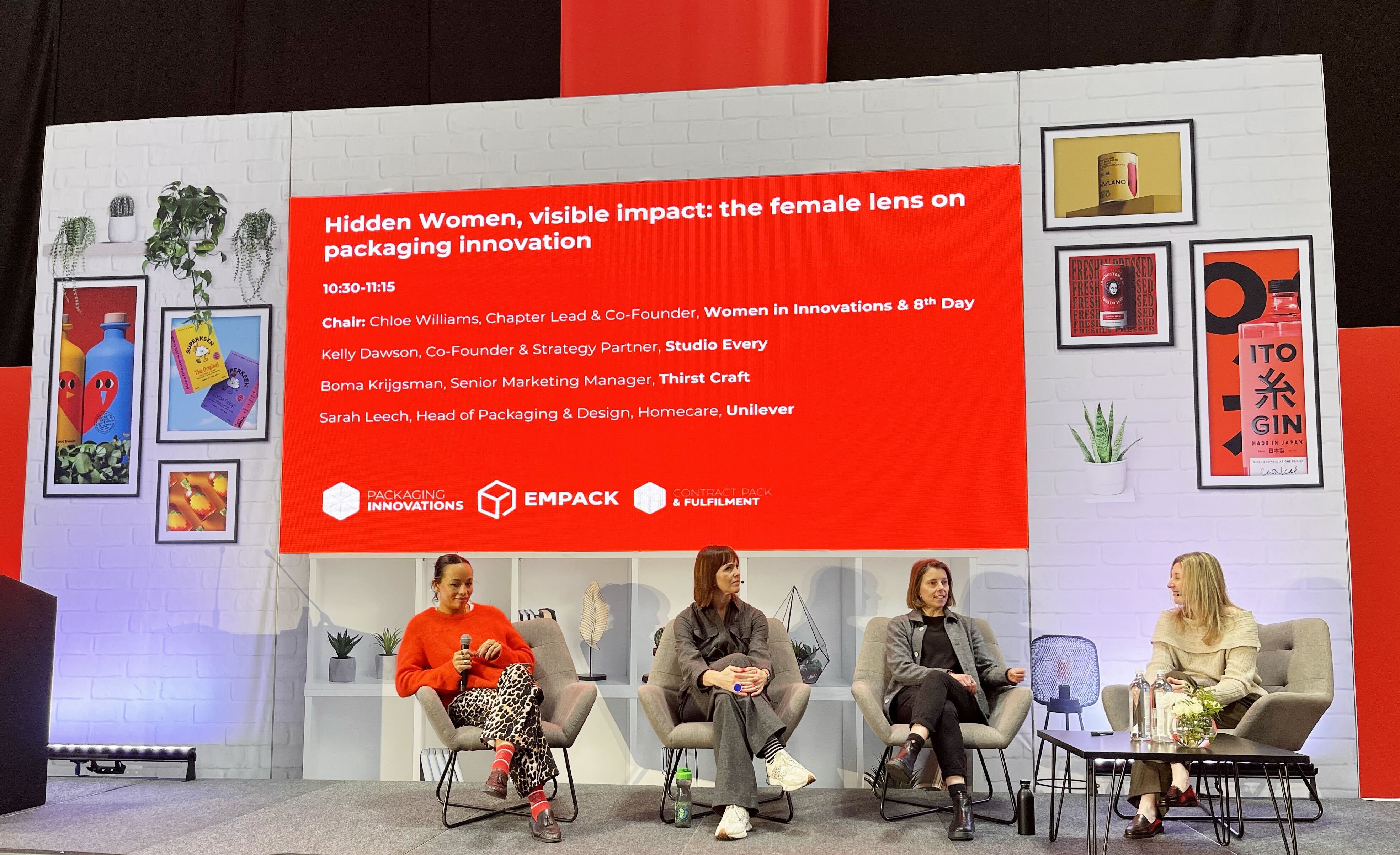
At WIN's recent panel, Hidden Women, Visible Impact: The Female Lens on Packaging Innovation, Chloe Williams – WIN London Chapter Lead and Co-Founder of 8TH DAY – led a dynamic conversation exploring how empathy-driven design translate into tangible innovation, cultural relevance, and commercial success.
Bringing together voices from across strategy, brand, and global manufacturing systems, the panel featured:
Kelly Dawson, Co-Founder & Strategy Partner, Studio Envy
Boma Krijgsman, Senior Marketing Manager, Thirst Craft
Sarah Leech, Head of Packaging & Design, Homecare, Unilever
Together, they unpacked a power question:
If women buy the majority of consumer goods – why do so many still feel overlooked in product design?
The Hidden Women Insight
Chloe opened the session with a key finding from 8TH DAY’s Hidden Women report, based on research with 2,700 women:
Only 1 in 10 women feel that their needs are considered in product design. One in ten. — Chloe Williams
That statistic reframed the entire discussion. If only one in ten women feels considered — what are the other nine doing? Are they adapting? Compromising? Finding workarounds? Quietly accepting friction as normal?
The panel quickly agreed: this isn’t about designing everything for women. It’s about recognizing where women’s lived realities are still invisible in the process.
Default Design Isn’t Malicious — It’s Distant
One of the most resonant insights came from Boma:
Default design doesn’t come from bad intent. I just think it comes from distance — distance from real life, distance from context. — Boma Krijgsman
That “distance” shows up in everyday moments: opening packaging one-handed while juggling a bag and a child. Trying to read tiny print in low light. Struggling with rigid materials that don’t flex to real hands.
Design often happens in controlled environments. Life does not.
For the WIN community, this is a powerful reminder: inclusion begins with proximity. With observation. With lived context.
The Gap Between Insight and Shelf
Sarah offered a valuable perspective from inside a global organization. She acknowledged that many brands do begin with women in mind:
The majority of fast-moving consumer goods are bought by women… so we always start with a woman as the consumer. — Sarah Leech
So why does it still go wrong? Because design intent can erode as projects scale:
Getting that design intent through to market is one of the hardest things that we have to do. — Sarah Leech
Global manufacturing systems, cost pressures, sustainability targets, and technical constraints all shape outcomes.
For innovators inside large organizations, this is an important takeaway: empathy must survive the system. It cannot be confined to the brief.
Functional Is the Foundation. Emotion Builds Loyalty.
Kelly reframed the conversation around emotional impact. Basic usability — grip, readability, accessibility — is table stakes:
I’ll call it functional foundation… getting the basics right. — Kelly Dawson
But emotional connection is where brands win:
How do you create emotion? How do you create that connection with people? — Kelly Dawson
Chloe linked this back to brand loyalty:
If women don’t feel a connection to a brand, they just move between them — there’s no loyalty. — Chloe Williams
In today’s world of digital commerce and social amplification, packaging isn’t just protective material — it’s the brand’s most consistent physical touchpoint. For WIN leaders globally: emotional intelligence in design is no longer optional. It’s commercial strategy.
Culture Is Shifting — Packaging Must Shift With It
The panel explored how women’s lives are changing rapidly:
• More single households
• Fewer children
• Longer lifespans
• Different shopping behaviors
• Increased digital commerce
Sarah highlighted how markets like China are redefining how packaging is experienced:
In China, 40% of FMCG is sold through digital commerce… and much of that through social commerce. — Sarah Leech
The first touchpoint is increasingly digital. The “moment of truth” may happen on a livestream before it ever happens in-store.
For WIN members operating globally, this underscores the importance of designing not just for shelves — but for screens, shipping, and social amplification.
AI: Opportunity and Bias
An audience question brought AI into the conversation. Chloe shared a striking example of algorithmic bias:
If a man and a woman with the exact same qualifications ask AI what salary to request, it will tell the woman to ask for less — because it’s trained on historic data. — Chloe Williams
Her warning was clear:
Is it designing for an old version of a consumer’s life, not the new version?
AI can enhance creativity, insight gathering, and cultural scanning. But without conscious oversight, it risks reinforcing outdated norms.
For the WIN community, this is a call to leadership. Inclusive innovation requires conscious governance of emerging tools.
The Line Between Support and Exploitation
One of the most thoughtful moments of the session came during a discussion about menopause branding.
Kelly posed a provocative question:
When do we take designing for women too far?
As menopause becomes more visible, some brands are rebranding entire product lines around it. The panel agreed there’s a balance to strike.
Sarah captured the tension:
Do I want to buy a shampoo that has menopause on it? No — because it stigmatizes. — Sarah Leech
The takeaway? Design should solve real needs — not label women as problems to monetise.
What Should We Retire?
When asked what packaging assumptions should be left behind, the answers were immediate:
• The pink tax
• Gender reductionism
• Over-reliance on demographics
• Designing for stereotypes rather than scenarios
As Boma summarised:
It should be less about gender and more about proximity to real life.
Key Takeaways
Design for context, not categories.
Lived moments matter more than demographic labels.Protect empathy through the system.
Insight must survive cost, scale, and technical constraints.Emotion is commercial.
Packaging is a brand’s most tangible touchpoint.Women are not one audience.
Attitudes, life stages, and culture shape needs far more than gender alone.Challenge AI bias early.
Inclusive innovation requires conscious data governance.Be careful not to commodify vulnerability.
Designing for women should empower, not stigmatize.
From Hidden to Visible
Chloe closed the session by reminding the audience that this conversation isn’t about exclusion. It’s about expansion.
For decades, packaging has been designed around a default consumer. The opportunity now is to design for everyone — not by overcorrecting, but by observing more closely.
When we reduce distance between design and lived reality, innovation becomes more inclusive — and more commercially powerful.
For WIN members across the globe, this panel was a clear signal:
Inclusive innovation isn’t a moral add-on.
It’s a growth strategy.
And when women’s realities become visible, the impact is anything but small.