back
What's Next, Now: WIN LDN x Future Friends
WIN x Future Friends & Miro
April 23, 2026
Health & Wellbeing
Investing
Social Impact
Design
Professional Development


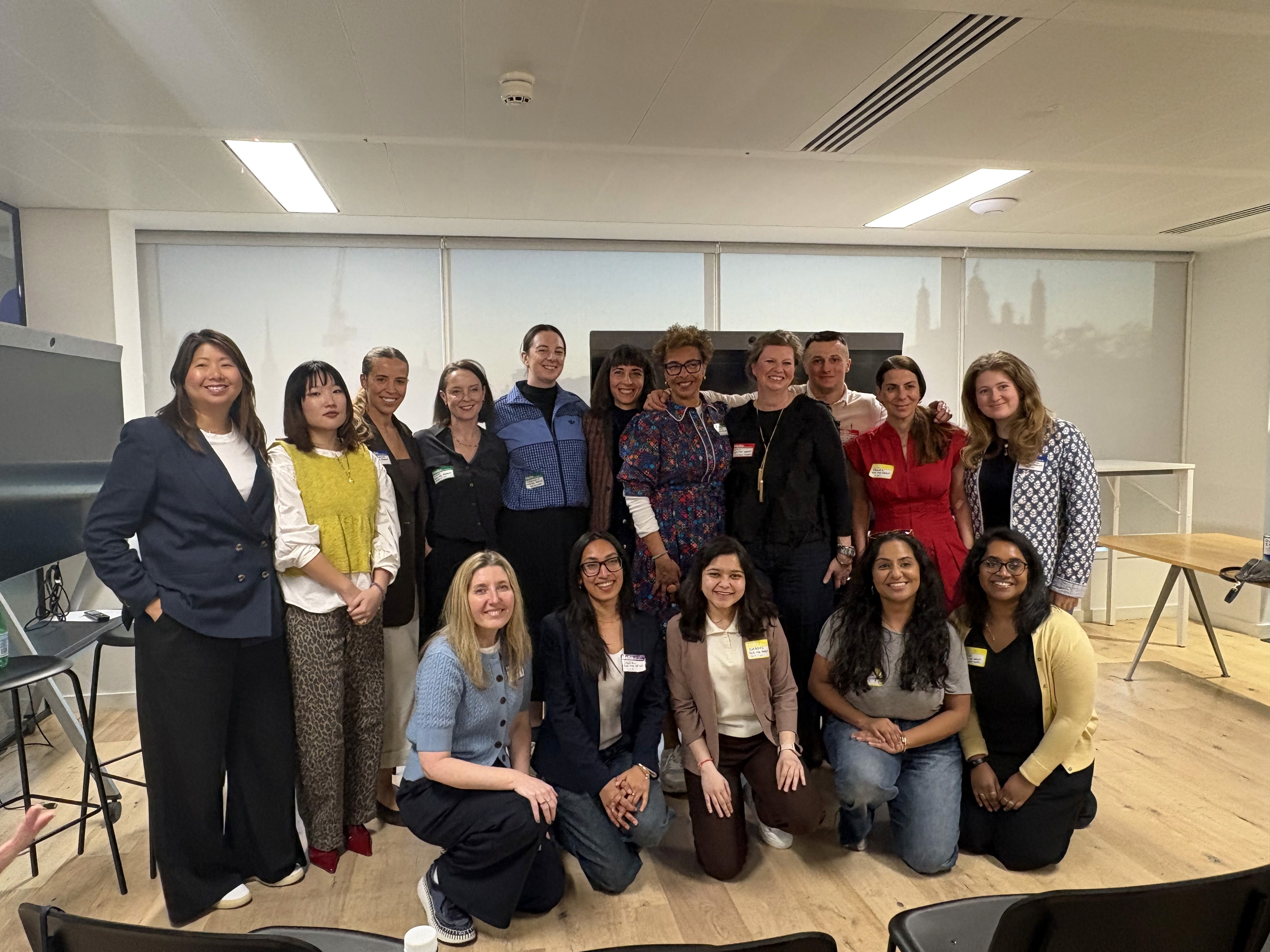
The latest Women in Innovation London event, in collaboration with Futures Friends, brought a sold-out room of people who don't wait to see what's next — they're usually the ones making it.
Ten brilliant minds across futurism, finance, research, sport and strategy took the stage with one question at the core: what's emerging now, and what does it mean for women building the future?
The 3x3x3 format — three trends, three slides, three minutes — kept things sharp, but rich enough to spark conversation afterwards.
Here's what we heard.
The Body Is the Next Frontier
Women’s health is no longer niche. It’s becoming one of the most consequential innovation spaces and the people closest to it are finally shaping it.
Rhiannon Jones, Futurist in Women’s Health, opened with a provocation: the rise of what she called “Mar-a-Lago Health” — hyper-visibility as a status signal, the body as something to be managed and corrected, where health, wealth and success are made visible rather than inferred. The tension she pointed to felt very present: one cultural current flattening biological reality, while another is trying to centre it more honestly.
Mia Clarke, Co-Founder of Studio On Brand and Women’s Health Advocate, moved into trust or the lack of it. Women are no longer relying on a single authority; they’re piecing together truth across networks. The shift isn’t just what is true? but how do people decide what to trust, and what gets passed on? What’s needed isn’t more information it’s better systems of distributed health intelligence.
Shirui Chen, Senior Strategist and Anthropologist in Material Culture at 8TH DAY, brought a different angle: time. Women’s timelines — biological, social, financial, emotional — don’t run neatly in parallel. They overlap, stretch, compress. Sometimes they feel urgent, sometimes already “too late.” Designing for women means designing for that complexity and giving people more agency over how they move through time.
The Wealth Shift Is Already Here
Capital is moving. And for the first time at scale, it’s moving toward women.
Vivienne Hsu, Partner at Anabasis Partners, shocked us with the “Invisible tax” impacting pensions meaning women would run out of money in four years vs. fourteen for me. She also laid out the positive swing in numbers: women currently control around a third of retail financial assets across the EU and US, rising to as much as 40–45% by 2030. In the EU alone, that’s projected to reach €11.4 trillion. The shift is already happening from women being treated as a segment, to becoming a central force in capital allocation.
Georgia Walkden, Financial Planner and Owner of Tailored Wealth and Money Matters, grounded this in behaviour. Money is being automated — saving, investing, decision-making — and the gap between those using these systems and those not is widening. Women often optimise the smaller, day-to-day decisions, but avoid the bigger, long-term ones. Busy doesn’t always mean building.
Clout Has Moved — From Broadcast to Trust
More voices hasn’t meant more influence. It’s made trust the scarce resource.
Amy Daroukakis, Global Community and Culture Strategist, mapped three cultural signals: a K-shaped economy quietly eroding the middle; the rise of “emotional data” — instinct, gut feel, therapy language entering professional spaces; and new rule-setting happening at the edges of culture. Her framing was simple but sharp: the most underused asset in your business isn’t your network or your credentials — it’s you.
Laetitia Sfez, Head of Research at intO, brought the lens of power and AI. The "9-9-6" culture in tech — long hours as the default — isn't just a work pattern, it's a filter. It excludes those with caring responsibilities and shapes who gets to build the systems that will define the future. The irony she left hanging in the room: the same AI being built behind those closed doors may eventually be what frees women from the domestic labour keeping them out. Whether that's promise or provocation depends entirely on who's in the room when the decisions get made.
Asha Dinesh, Research Lead at Miro, focused on what this looks like inside organisations. As AI lowers barriers to execution, roles are starting to blur — designers prototyping, engineers designing, PMs coding. That shift towards generalism creates real openings, particularly for women. But it also raises a harder question: what does expertise mean when the tools keep changing? And finally as we’re all working longer will we start career swerving…
The New Innovation Frontiers
Some of the most interesting work right now is happening at the edges — where categories are breaking down and being rebuilt.
Michael McCann, broadcaster and long-time advocate for women’s sport, looked at the shift from legacy media to player-led narratives. Traditional systems haven’t served women’s sport well but new ones are emerging in their place. Athletes, coaches, and communities are building direct relationships with audiences who want something more human, more authentic. Even physical spaces are catching up from stadium design to new standards built around different audiences.
Remi Baker, Founder of The Third Chapter, turned to longevity and identity. As life expectancy increases, the idea of reinvention is starting to shift. Less about becoming someone new, more about returning to self. Less reinvention, more reclamation. As traditional life stages loosen — and retirement becomes less defined — designing for longer, non-linear lives becomes one of the biggest opportunities ahead.
Why This Matters for WIN
Across the evening, a few things became clear.
Community is becoming currency.
Clout is moving from broadcast to trust.
Command is being reshaped by AI.
And capital — slowly, but significantly — is moving toward women.
These aren’t abstract trends. They’re the conditions people are already navigating — and the reason spaces like WIN matter.
Not one industry. Not one job title. Not one kind of innovator.
Anyone building the future.
We’re grateful to every speaker who shared their thinking — and to Future Friends and Miro for making it happen.
Want to be part of the next one? Sign up to the WIN newsletter.